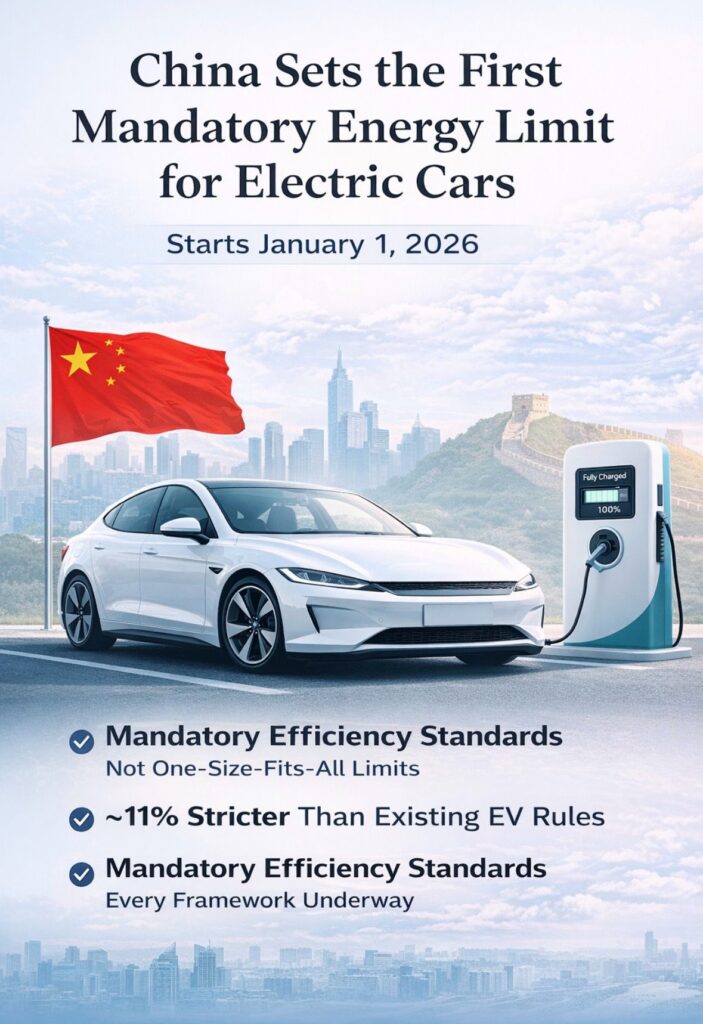
Starting January 1, 2026, China will introduce the world’s first mandatory energy-consumption limit for battery electric passenger cars.
👉 This is not a guideline.
Vehicles that fail to meet the requirement cannot be sold.
✅ A Shift From Voluntary to Mandatory
Unlike earlier efficiency standards, the new rule sets hard upper limits on electricity consumption.
Compliance is no longer optional, marking a significant tightening of EV regulation.
✅ Not One-Size-Fits-All
The limits are based on vehicle weight, rather than a single benchmark.
Regulators say the thresholds are about 11% stricter than the previous recommended standard, while accounting for different vehicle classes and technologies.
✅ Why This Matters
For years, EV competition focused on extending range, often by adding larger batteries and accepting higher energy use.
China’s new approach challenges that model by prioritizing efficiency over capacity.
✅ Engineering Implications
Automakers will need improvements across the entire vehicle system, not just the battery.
Powertrain efficiency, lightweight design, aerodynamics, thermal management, and software-based energy control all become critical.
✅ Global Impact
As the world’s largest EV market, China’s standards tend to shape global manufacturing strategies.
By enforcing efficiency at scale, Chinese automakers are being pushed to prepare for future carbon and efficiency rules worldwide.
✅ The Bigger Signal
This policy suggests the next phase of EV competition will be defined less by battery size.
And more by how efficiently every kilowatt-hour is used.
✍️ What are your thoughts about this new standard?