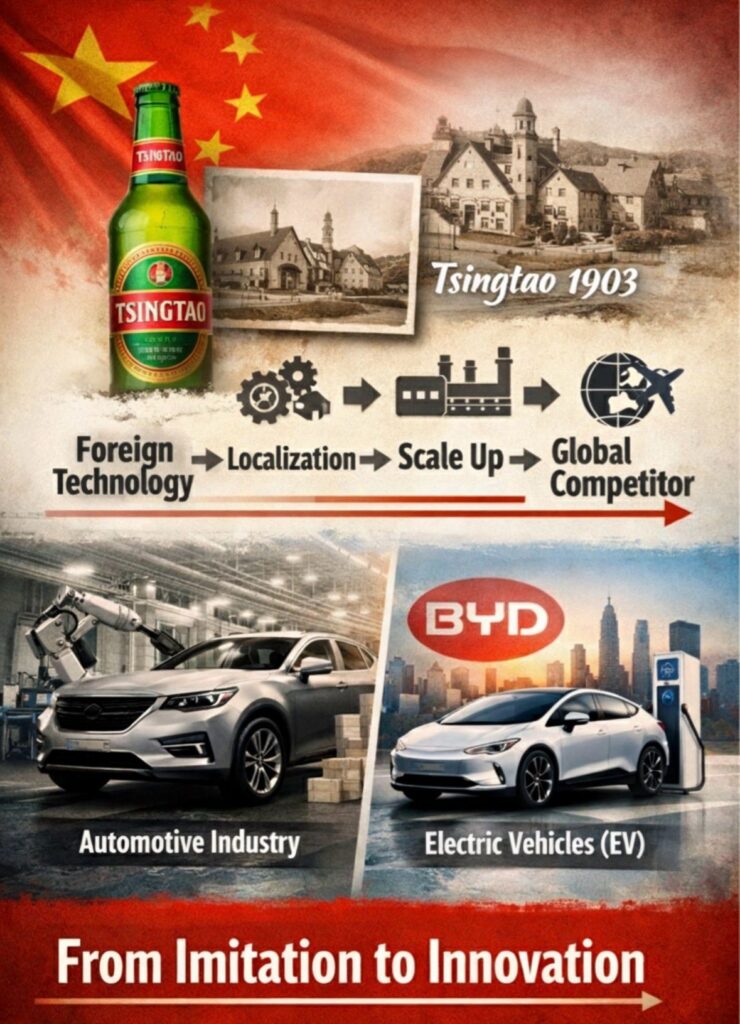
Founded in 1903 by German brewers in Qingdao, Tsingtao began with foreign technology, standards, and expertise.
Over time, those capabilities were localized, ownership shifted, and the brand became part of China’s industrial system.
The result was not a European replica, but a Chinese national champion with global reach.
That path: foreign technology → localization → scale → global expansion, has repeated across China’s economy.
The auto industry followed the same logic.
Early joint ventures with Volkswagen and General Motors transferred manufacturing systems, vehicle architectures, and quality processes into China.
For years, these partnerships were seen mainly as market-access deals for Western brands.
What mattered more came later.
Chinese automakers absorbed the know-how, rebuilt platforms around local supply chains, and compressed development cycles.
The shift became clearer in electric vehicles.
Without legacy combustion constraints, companies like BYD moved from adopters to global competitors with remarkable speed.
As with Tsingtao, early imitation masked what was really happening: systematic industrial learning.
The lesson isn’t about copying.
It’s about learning velocity.
In China, competitive advantage is often built quietly, long before it becomes obvious in global market-share numbers.