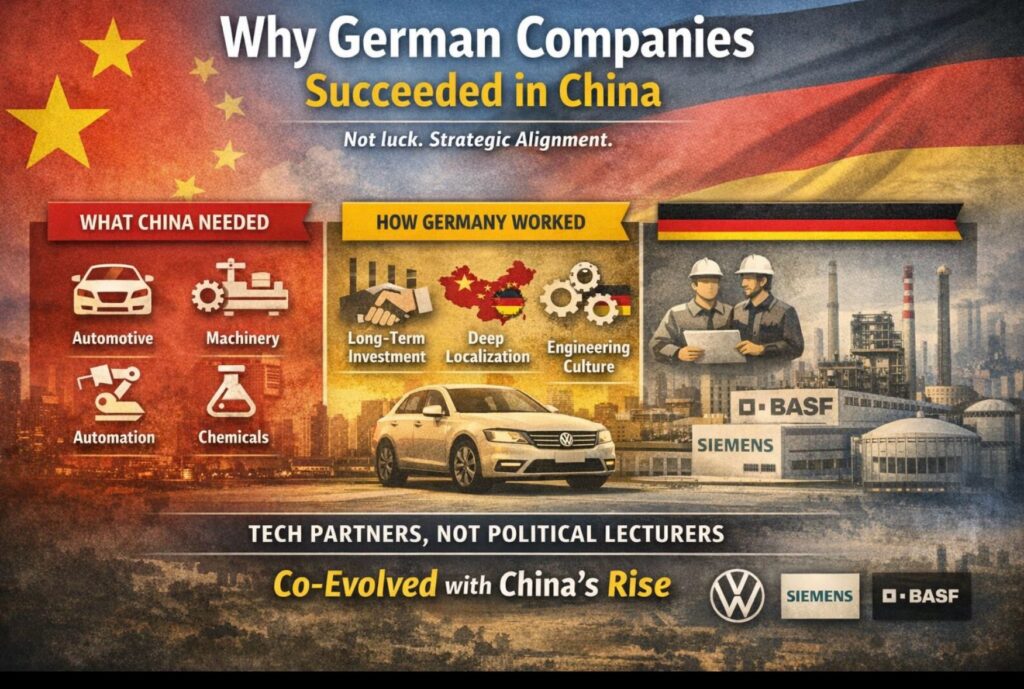
For decades, German companies have been unusually successful in China.
Volkswagen, Siemens, Bosch, BASF…
This wasn’t about branding.
It was about alignment.
✅ China’s core mission since the 1980s was simple:
Build a modern industrial economy.
✅ Germany’s core strength was exactly that:
• Automotive engineering
• Industrial machinery
• Automation & controls
• Chemicals
• Precision manufacturing
Germany sold what China needed most.
But product fit alone wasn’t enough.
✅ Three deeper reasons explain the success:
1️⃣ Long-term mindset
German companies invested for decades, not quarters.
They built factories, supplier networks, and training systems, not just sales offices.
2️⃣ Deep localization
They localized manufacturing, engineering, and management early.
China was treated as a home market, not a low-cost outpost.
3️⃣ Engineering culture
China respects engineers, process discipline, and incremental improvement.
German industrial culture matched that respect naturally.
✅ There was also a political dimension:
Germany was seen as a technology partner, not a political lecturer.
👉 The result?
German firms didn’t just enter China — they co-evolved with China’s industrial rise.
Today, the environment is changing.
Chinese companies are no longer just learning — they’re competing.
✍️ But the lesson remains timeless:
Countries and companies win abroad not by selling harder,
but by aligning deeply with what the market is trying to become.
That’s the real German advantage in China.