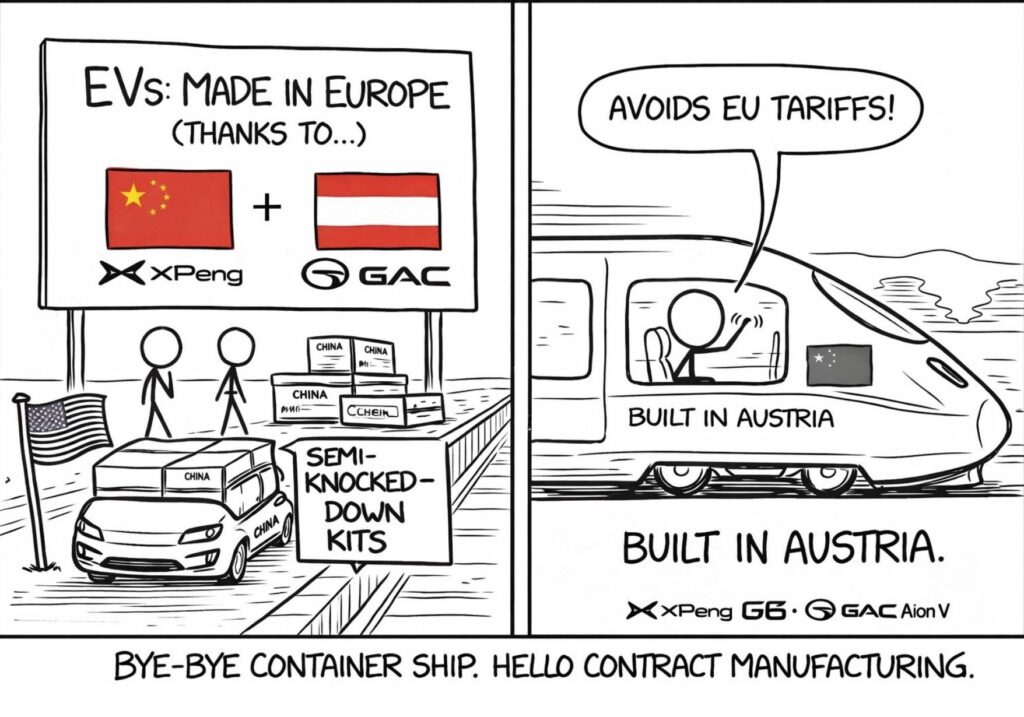
In the quiet Austrian city of Graz, something fascinating is happening inside the factories of Magna Steyr.
These are the same assembly lines that produced the legendary Mercedes-Benz G-Class and vehicles for Jaguar Land Rover.
Now they’re building cars for China’s EV challengers.
Partnerships between Magna International and Chinese automakers like XPeng and GAC Group are turning Austria into an unexpected gateway for Chinese EVs into Europe.
But the real story isn’t manufacturing.
It’s strategy.
The New Trade Playbook
Instead of shipping fully built cars to Europe, Chinese companies send semi-knocked-down (SKD) kits to Austria.
Final assembly happens at Magna.
👉 That simple step changes everything:
• Tariffs shrink – avoiding the EU’s ~20% anti-subsidy duties on Chinese EV imports.
• Perception shifts – vehicles like the XPeng G6 and GAC Aion V can now carry the credibility of European assembly.
• Risk disappears – no need to invest billions in new factories.
✅ Why Magna Wins Too
For Magna International, this is a perfect match.
As legacy programs wind down, Chinese EV makers are filling the production gaps.
Idle capacity becomes strategic infrastructure.
👉The Bigger Shift
In the past, global auto competition was about engineering, scale, and brand.
Today it’s also about navigating geopolitics and trade barriers.
And Chinese EV makers are proving something important:
Sometimes the fastest road into Europe
isn’t through a port.
It’s through a contract manufacturer in the Alps.
✍️ Question for the industry:
Will Europe’s tariff strategy slow Chinese EVs — or simply reshape how they enter the market?