It’s not a talent problem.
It’s an architecture problem.
Legacy OEMs were built for stability.
New EV players were built for speed.
That difference changes everything.
1. Legacy automakers are trapped in supplier dependency.
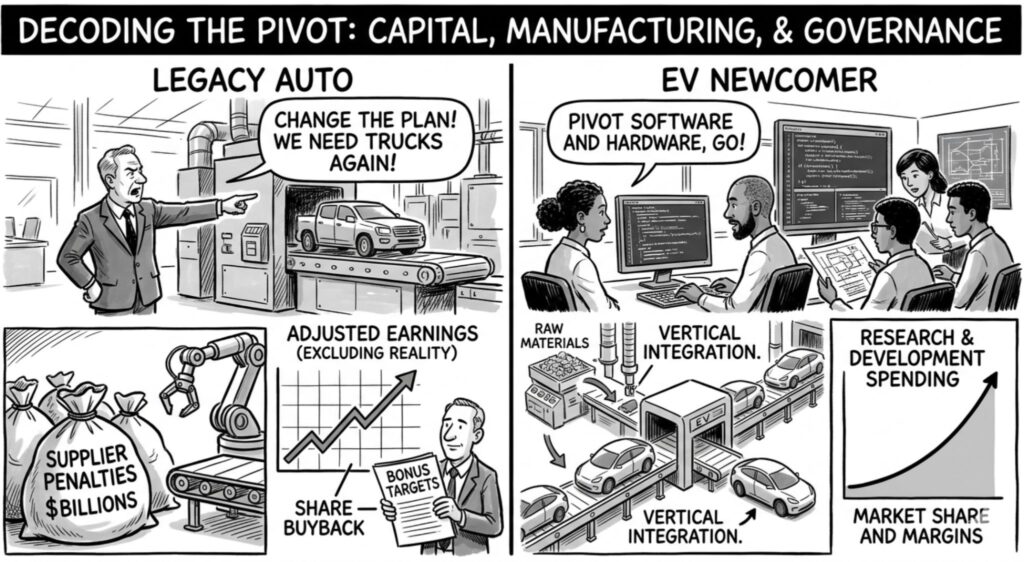
When a traditional OEM cancels or reverses an EV program, the penalties are massive.
A single factory pivot can trigger billions in supplier contract costs because the entire system depends on external Tier 1 tooling, volume guarantees, and rigid production agreements.
Cancel the volumes?
You still pay.
Now compare that with vertically integrated players like BYD.
They build batteries.
Semiconductors.
Software.
Motors.
When demand shifts, they reallocate internal capacity instead of writing billion-dollar checks to suppliers.
They don’t sue themselves.
2. The incentive systems are completely different.
In legacy carmakers, leadership is often insulated from operational failure through financial engineering.
Factory losses become “special items.”
Write-downs get excluded from adjusted earnings.
Share buybacks help maintain EPS targets even when execution struggles.
The result:
Executives can miss the future while still hitting compensation metrics.
✅ Meanwhile, founder-led EV companies operate differently.
Execution is the scoreboard.
Market share.
Cost reduction.
Manufacturing scale.
Product iteration speed.
That’s why companies like Xiaomi pushed their EV business toward profitability so quickly.
Capital went into engineering, supply chain control, and rapid iteration — not financial insulation.
3. The real divide isn’t East vs. West.
It’s industrial-era governance vs. tech-era governance.
One system rewards risk mitigation.
The other rewards aggressive scaling.
One optimizes quarterly optics.
The other optimizes manufacturing velocity.
And in the EV era, velocity compounds faster than protection.
👉 The uncomfortable reality:
Many legacy automakers aren’t losing because they can’t build great vehicles.
They’re losing because their organizational structure was designed for a slower industrial age.
Until incentives change, billions will continue to be spent defending the past instead of building the future.