For nearly a century, automotive luxury was a game of centimeters and silhouettes. A long, sweeping hood, a cabin pushed aggressively over the rear axle, and a massive, structural chrome grille were more than styling choices; they were the visual signatures of mechanical supremacy.
Today, that entire visual lexicon is hitting a brick wall.
As the global automotive industry pivots toward software-defined electric vehicles, legacy giants from Munich to Detroit are facing an existential identity crisis. Stripped of the internal combustion engines that once dictated their classic proportions, traditional Original Equipment Manufacturers (OEMs) are struggling to design vehicles that look like the future without erasing the heritage that keeps them profitable.
The resulting identity crisis was perfectly captured in a recent viral meme showcasing a BMW concept alongside an internet parody (shown below). On the left, BMW’s serious “Neue Klasse” electric sport-utility concept flattens its iconic kidney grille into an illuminated, horizontal digital mask. On the right, internet satirists morph the front end into a literal, organic pink pig snout.
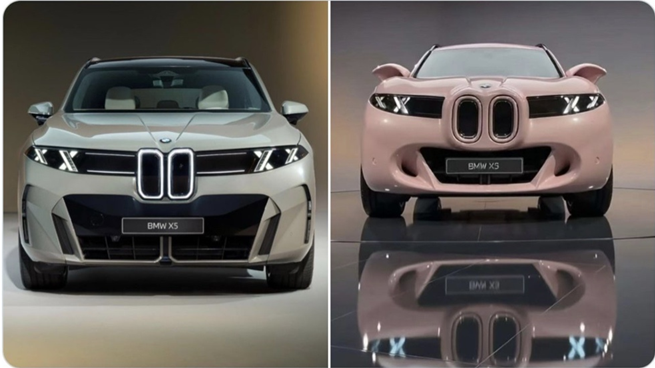
The message from consumers is brutal, clear, and widespread: in trying to force yesterday’s branding onto tomorrow’s skateboard architecture, legacy automakers risk turning themselves into caricatures.
The root of the problem isn’t a lack of talent in the design studios; it is a fundamental shift in physics and industrial packaging.
Internal combustion vehicles required long engine bays to house multi-cylinder engines and complex cooling systems. Dedicated electric vehicle platforms, by contrast, utilize a flat “skateboard” chassis where the battery sits in the floor and the electric motors occupy minimal space.
This architecture allows, and frankly demands, a “cab-forward” layout: short hoods, stretched wheelbases, and massive cabin volumes designed to maximize aerodynamic efficiency and interior space.
For clean-sheet electric vehicle startups like Tesla, Rivian, or China’s tech-backed titans Xiaomi and BYD, this structural blank canvas is a massive competitive advantage. Unburdened by history, they can optimize their shapes purely for the wind tunnel and a minimalist, consumer-electronics aesthetic.
“Startups can design a car purely for the software-defined era,” says an industry analyst focusing on automotive manufacturing trends. “They aren’t obligated to carve out space for a faux radiator intake. They put a LiDAR sensor or an aerodynamic curve where a grille used to be, and the market accepts it as high-tech.”
For legacy luxury brands, however, that same blank canvas looks terrifyingly like an erasure of their brand value.
If a BMW doesn’t look like a BMW from 100 yards away, why should a consumer pay a 30% premium over a mainstream electric vehicle?
In an era where electric powertrain performance is rapidly becoming commoditized – where 0–60 mph times are cheap and battery ranges are converging – visual identity and brand prestige are the final moats protecting legacy margins.
This dynamic has forced legacy companies into defensive design loops. BMW’s “Neue Klasse” design language, which will roll out across its global fleet over the next few years, is an ambitious attempt to bridge this divide. By turning the classic kidney grille into a “phygital” graphic element that blends physical lines with animated LED lighting, the company hopes to maintain its historic face on an aerodynamic EV footprint.
But as the parody in the picture above highlights, the margins for error are razor-thin. When an iconic, mechanically functional feature is shrunk, stretched, or illuminated artificially to fit a blunt, upright crossover front fascia, the human brain often rejects the compromise, viewing it as awkward or comical rather than premium.
BMW isn’t alone in this trap. Mercedes-Benz faced similar criticism when it smoothed its traditional luxury sedans into the hyper-aerodynamic, jellybean-shaped EQS lineup, which critics argued lacked the commanding road presence of the classic S-Class.
For now, many traditional automakers are hedging their bets through a dual-track manufacturing strategy. BMW, for example, is running its dedicated electric Neue Klasse platform parallel to its highly flexible, combustion-capable CLAR architecture well into the next decade. This gives them the flexibility to scale gas, hybrid, and electric models based on real-world demand, but it also means their design studios must continue serving two masters.
Ultimately, the cartoonish “pig snout” parody on the right side of the picture above is the exact tax legacy brands must pay to stay alive. When a company refuses to completely let go of its past, it will occasionally produce a caricature of itself. But in a brutal global market increasingly dominated by low-cost tech entrants, being lampooned on car forums is still far better than being completely forgotten.
The design transition isn’t just happening on paper; it’s playing out on real factory floors. For a deeper look at how this new design philosophy translates from concept to assembly, you can watch BMW Neue Klasse iX3 Design Deep Dive, which explores the balancing act between physical form and digital illumination.
Great content! Keep up the good work!
Interesting