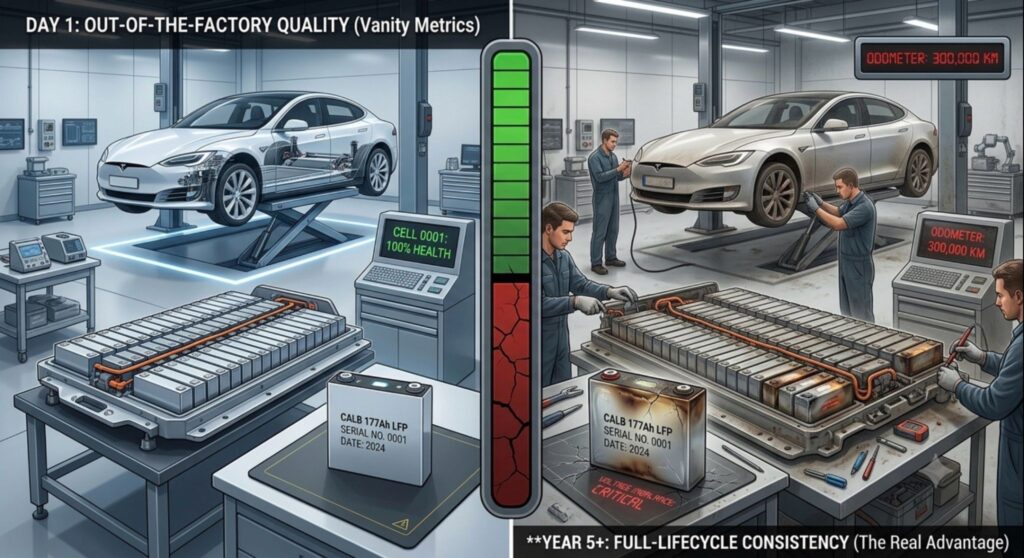
Out-of-the-factory quality is a vanity metric.
Full-lifecycle consistency is the real competitive advantage.
Recently in China, a massive batch of 177Ah LFP battery cells in high-use EV fleets began failing between 150,000 and 300,000 km.
The symptoms:
↳ Severe cell-to-cell voltage imbalance
↳ Sudden, unexpected range drops
↳ High-voltage insulation faults
↳ Complete vehicle shutdowns
These cells passed initial inspection.
They worked perfectly on Day 1.
So, what actually went wrong?
1. Micro-tolerances compound exponentially
A 0.5% variance in electrode coating or electrolyte volume seems harmless at 0 km.
After 2,000 fast-charging cycles, that tiny manufacturing delta becomes a dead cell.
2. The low-cost trap catches up
Aggressive price wars force suppliers to squeeze manufacturing precision and loosen cell-sorting standards.
You don’t actually save money, you just defer the cost to future warranty claims and brand damage.
3. Software can’t fix bad hardware
A smart BMS can balance cells and predict faults, but it cannot reverse physical cell swelling, lithium plating, or insulation degradation.
The EV industry is entering a new era:
Phase 1: Race for energy density, range numbers, and lowest cost per kWh.
Phase 2: Race for manufacturing precision, durability, and 300,000 km lifecycle consistency.
If your product only looks good on the showroom floor, you haven’t built a great product.
You’ve built a ticking clock.
✍️ Are automakers paying enough attention to long-term hardware reliability, or is speed-to-market still eating quality for breakfast?