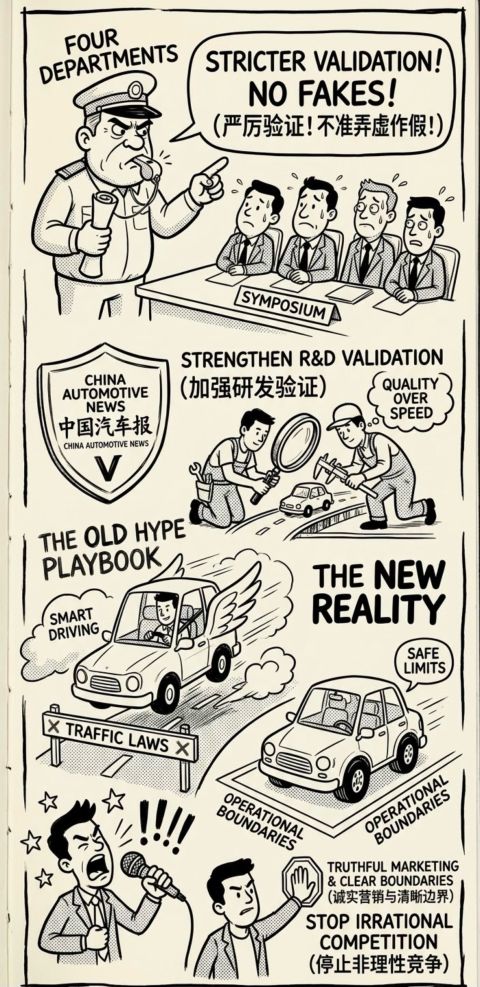
Beijing called 30+ auto executives into a room.
The message was simple:
Stop cutting corners on testing.
Stop over-promising on software capabilities.
Here is what happened and why it matters:
Four major government departments (including MIIT) just laid down new ground rules for the automotive industry:
1. The End of “Hype Marketing”
No more misleading ADAS/smart-driving claims.
No promotional videos showing traffic law violations.
OEMs must explicitly state operational limits and safety boundaries.
2. Enforced R&D Rigor
Strict mandate to “resist irrational competition” (i.e. brutal price wars compromising quality).
Tighter safety baselines and accelerated standard updates.
Mandatory R&D validation before products hit the street.
3. Public Accountability
Regular supervisory inspections on auto manufacturers.
Publicly naming and shaming non-compliant brands.
The Big Takeaway:
For years, the playbook in China was speed over everything.
Shorter development cycles.
Faster feature deployments.
Aggressive marketing claims.
That era is officially coming to an end.
Beijing is shifting the industry focus from unbridled growth to quality control and safety standardization.
If you’re building, supplying, or competing in the global EV market:
Validation and truth in marketing aren’t optional anymore, they are the core product strategy.
How do you see tighter testing regulations impacting EV development timelines?