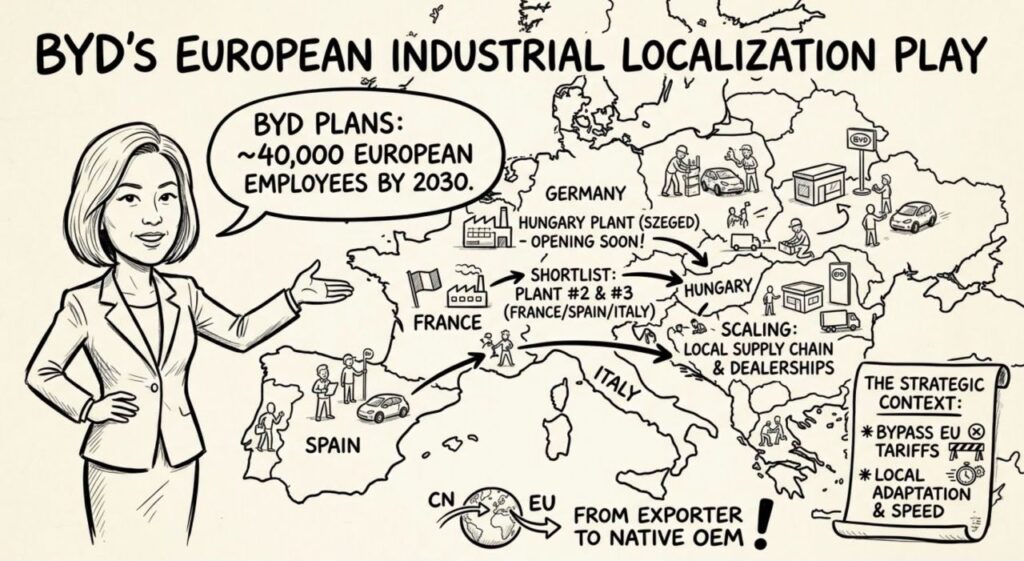
Speaking at the Paris Motor Show, Executive Vice President Stella Li confirmed that the company plans to build a workforce of nearly 40,000 employees in Europe.
This is not just an import strategy, it’s a massive industrial localization play.
Here is what BYD’s European footprint is shaping up to look like:
• Hungary Facility: Opening its first European passenger car assembly plant in Szeged.
• Plant #2 & #3: Actively vetting sites for additional manufacturing capacity. France is officially on the shortlist, driven by competitive energy costs, alongside Spain and Italy.
• Localized Ecosystem: Scaling up local engineering, dealership networks, and supply chain partnerships to operate as a native European OEM.
The Strategic Context:
1. Navigating EU Tariffs: In-region assembly bypasses anti-subsidy countervailing duties on imported Chinese EVs.
2. Speed & Scale: Transitioning from an exporter to a local manufacturer lets BYD adapt faster to European consumer preferences and regulatory environments.
The shift from global exporting to full-scale local manufacturing is accelerating faster than expected.
✍️ How do you see traditional European OEMs responding as Chinese automakers build out local manufacturing footprints inside the bloc?