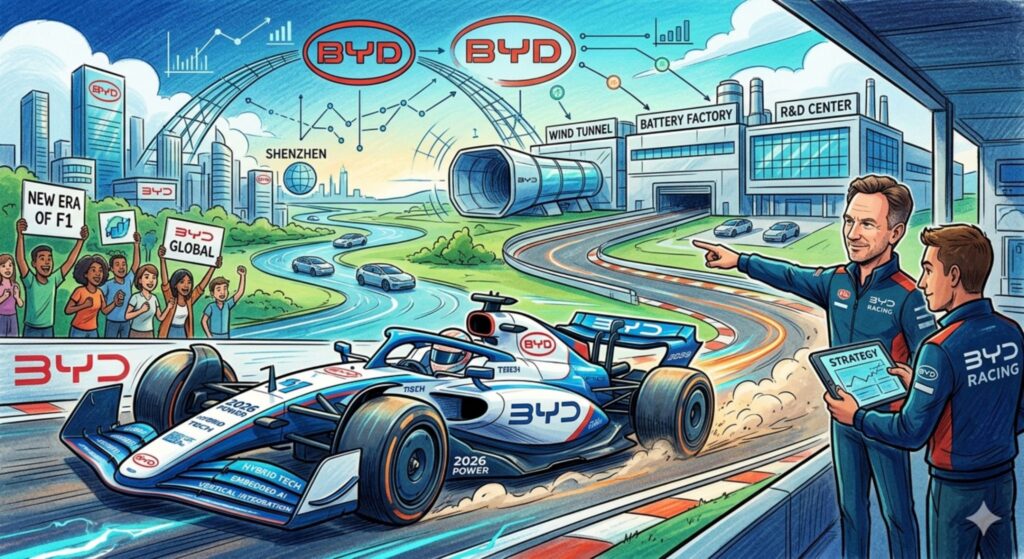
BYD is reportedly exploring an entry into Formula 1.
Not as a sponsor.
Not as a powertrain supplier.
As a fully factory-owned 12th team.
And possibly with Christian Horner leading the project.
If true, this isn’t just motorsport news.
It’s a strategic signal.
Here’s why this move makes perfect sense:
1. F1’s 2026 rules align with BYD’s strengths
The next-generation regulations push F1 toward a near 50/50 split between combustion and electric power.
That matters.
BYD didn’t build its empire on V8 heritage.
It built it on batteries, electric systems, and highly efficient hybrids.
For them, F1 becomes more than branding.
It becomes a live R&D platform.
2. Vertical integration could become a competitive weapon
Most F1 teams rely on deeply specialized supplier networks.
BYD operates differently.
They build batteries.
Semiconductors.
Electric drivetrains.
Core systems.
In-house.
If they enter F1, we may witness a fascinating clash of operating models:
• Motorsport Valley precision engineering
vs.
• Shenzhen-style manufacturing speed and integration
That could change how quickly innovation moves through the grid.
3. F1 gives BYD something money can’t easily buy
Prestige.
BYD already dominates EV volume.
But Formula 1 is about perception.
A factory team instantly elevates engineering credibility on a global stage.
Especially in Europe.
This is how you move from “high-volume EV maker” to a premium global technology brand.
Of course, getting a 12th team approved won’t be easy.
Politics.
Anti-dilution fees.
Resistance from incumbent teams.
But the commercial gravity of the Chinese market is hard to ignore.
Whether it happens in 2026 or 2027, one thing feels clear:
The line between mass-market manufacturing and elite motorsport is disappearing.
And the next era of F1 may look a lot more like the future of the global auto industry.
What do you think?
Could a vertically integrated tech giant outperform the traditional F1 supplier ecosystem?