Auto stop-start systems were engineered to save fuel and help automakers hit government emissions targets.
Instead, they’ve become a ticking time bomb for vehicle reliability.
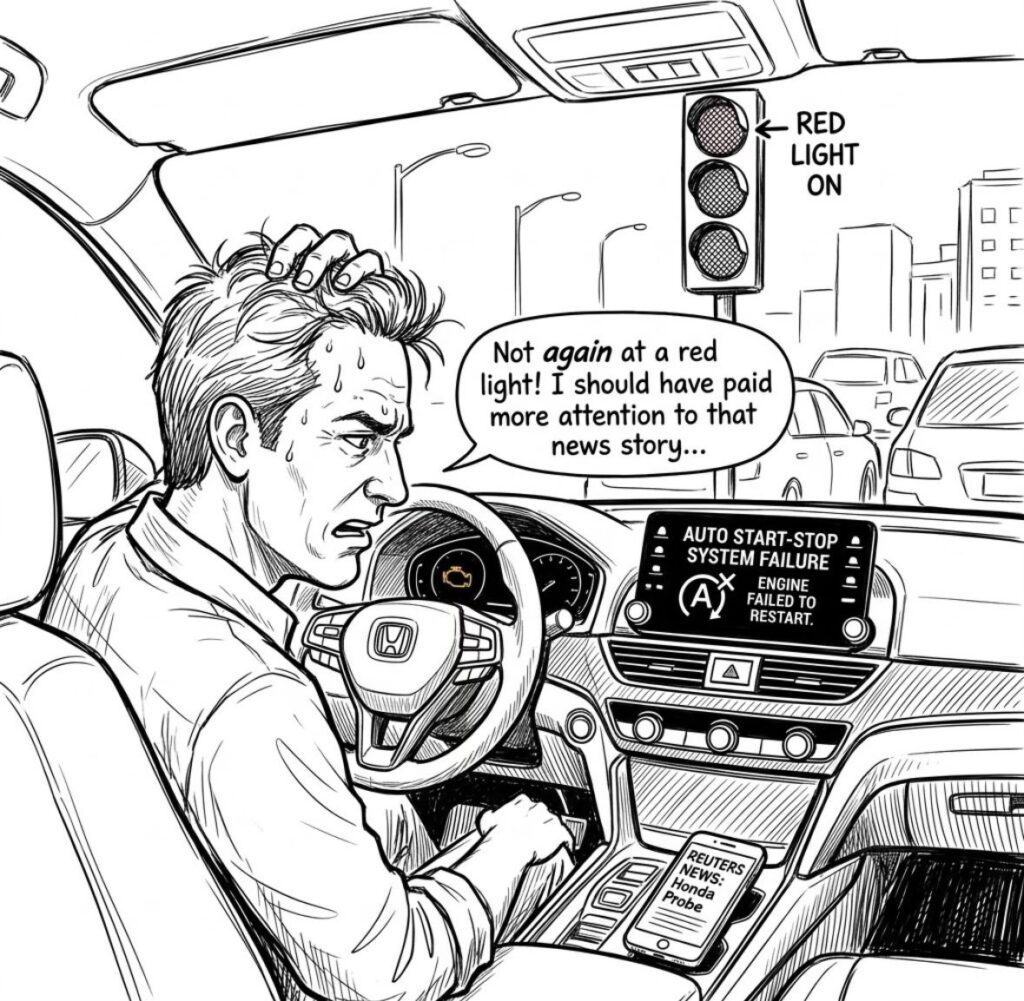
Case in point: NHTSA just opened an engineering analysis into 1,033,632 Honda vehicles because their engines are failing to restart after shutting off at traffic lights.
Here is what most drivers miss about the hidden math and engineering of stop-start systems:
1. The Fuel Savings vs. Maintenance Trap
Under heavy city driving, stop-start saves roughly 5% to 8% in fuel. Over 100,000 miles, that equates to about $500–$1,000 in gas.
Sounds like a win?
Not when you factor in the hardware penalty:
AGM Batteries: Cost $150–$250 more than standard flooded batteries and degrade faster due to continuous micro-cycling.
Replacement Frequency: Needing an extra battery replacement over the vehicle’s life eats up most of those fuel savings.
Component Fatigue: Outlier starter or relay failures on heavily cycled systems can run $800+ out of warranty.
For suburban and highway drivers, the fuel savings are practically zero, but the electrical wear remains 100% active.
2. The Brutal Physics of Cranking
A traditional vehicle cranks 1 to 2 times per trip.
A stop-start vehicle cranks dozens of times per trip.
Over a vehicle’s lifespan, that translates to tens of thousands of high-current thermal and mechanical spikes. Even with upgraded starter motor bushings and reinforced solenoids, physics always catches up.
3. The Software Handoff Vulnerability
When you lift your foot off the brake, a complex sequence must fire instantaneously:
Crankshaft position sensors, fuel injection resumption, ignition timing, and 12V transient voltage stability.
When a battery’s State-of-Charge dips slightly or cabin thermal loads spike, the powertrain control module can get confused.
The result? A dangerous hesitation, or complete stall, in active traffic.
The Takeaway
Regulators pushed stop-start as a low-cost compliance win for corporate average fuel economy.
But the real-world trade-off is premature component wear and compromised reliability.
Systems should serve the operator, not just checkbox compliance.
✍️ What’s your take?
Do you leave auto stop-start active, or is it the first button you press when you start the car?