Not for fun. For survival.
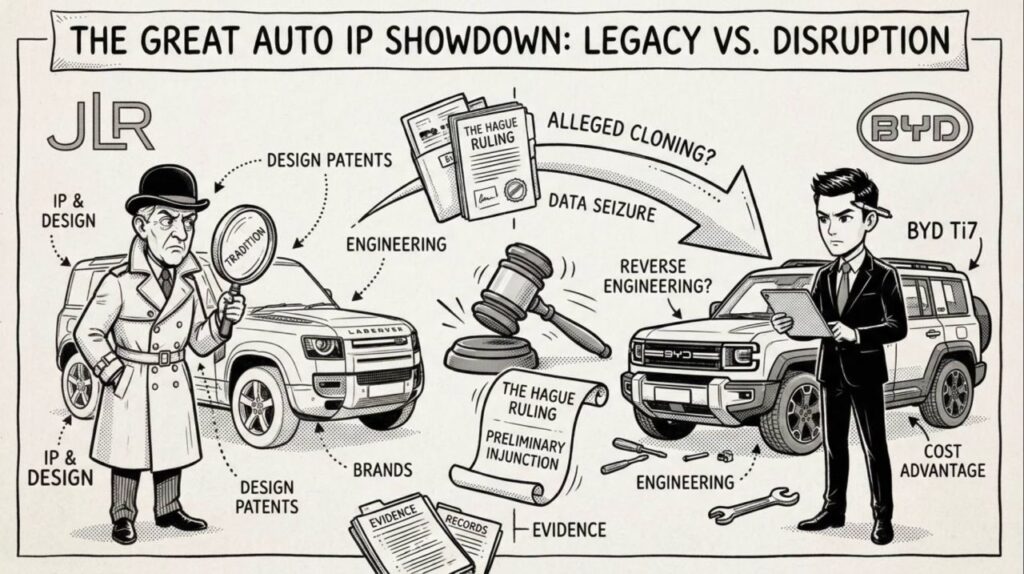
The dispute? JLR claims BYD’s new Ti7 SUV didn’t just borrow design cues from the Land Rover Defender…
They claim BYD bought a Defender, tore it down piece-by-piece, and cloned its structural engineering.
Court-appointed bailiffs seized server records in the Netherlands ahead of a hearing at The Hague.
Here is why this isn’t just an auto industry headline:
It’s a masterclass in market friction.
1. The Price Gap
A base Defender 110 starts around £64,000 in the UK.
BYD’s Ti7 enters at £47,995 – loaded with 400+ hp and a plug-in hybrid setup.
When legacy incumbents lose price leverage, their last defense is IP protection.
2. The “Teardown” Grey Area
Benchmarking a competitor’s product is standard practice in almost every industry.
Copying proprietary CAD data or patented utility architecture is illegal.
The line between “learning from the leader” and “unlawful cloning” is razor thin.
3. The Playbook shift
Ten years ago, legacy brands ignored copycats because execution was poor.
Today, the challenger brands execute fast, scale globally, and price aggressively.
If you build a premium product, your moat cannot just be:
• Brand heritage
• Aesthetic design
• High margins
If someone can replicate 80% of your value proposition at 70% of your price, the market moves.
The real lesson for founders and operators?
When challenger models target your core business, you can’t out-sue a structural cost advantage long term.
You have to out-innovate it.
What’s your take, does JLR have a case?
👇 Let me know in the comments.