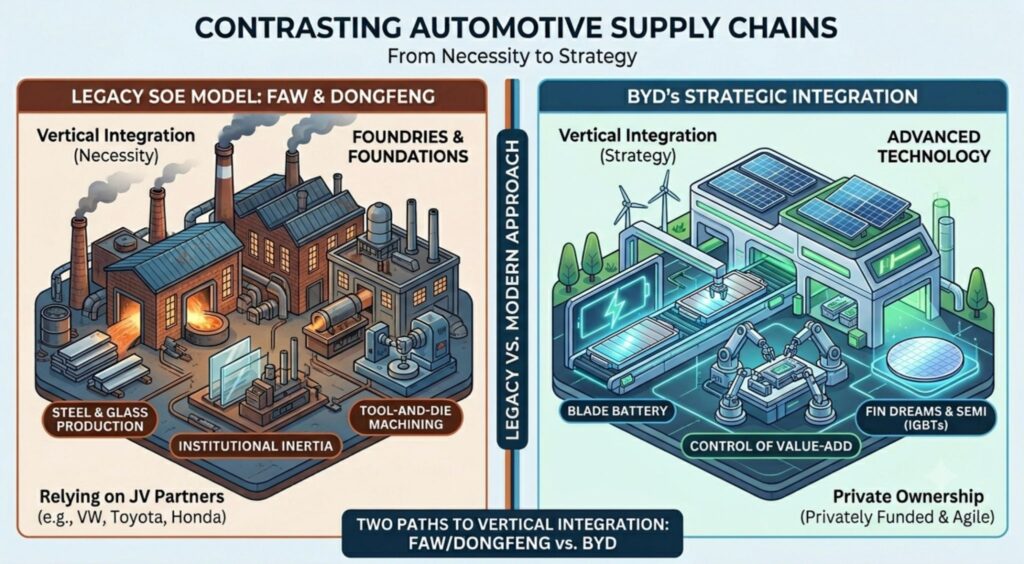
For decades, giants like China’s FAW and Dongfeng used it to survive.
Today, BYD uses it to dominate.
Here is the breakdown of why one failed and the other won:
1. Necessity vs. Strategy
Legacy manufacturers built everything in-house because they had to.
In the 1950s, there was no supply chain. They integrated the “Body” – foundries, steel, and housing.
BYD integrates because it’s a competitive advantage.
They own the “Brain” – batteries, semiconductors, and motors.
The Lesson: Integration should solve for speed, not just existence.
2. The Dependency Trap
Joint Ventures (JVs) were a goldmine for FAW and Dongfeng. But easy money breeds lethargy.
They became world-class assemblers for foreign brands but lost the muscle memory to innovate.
BYD had no safety net. As a private player, they had to build their own tech stack or die.
3. Killing “Contractual Friction”
Traditional OEMs are slowed down by external dependencies.
New spec? Negotiate with a supplier.
Change order? Legal review.
Validation? Wait 6 months.
At BYD, that negotiation is an internal meeting. They’ve replaced legal friction with engineering agility. That is how you achieve “China Speed.”
The Bottom Line:
Vertical integration is a relic if it’s about commodities.
It’s a weapon if it’s about core technology.
If you don’t control your most expensive components, you aren’t a manufacturer.
You’re a middleman.