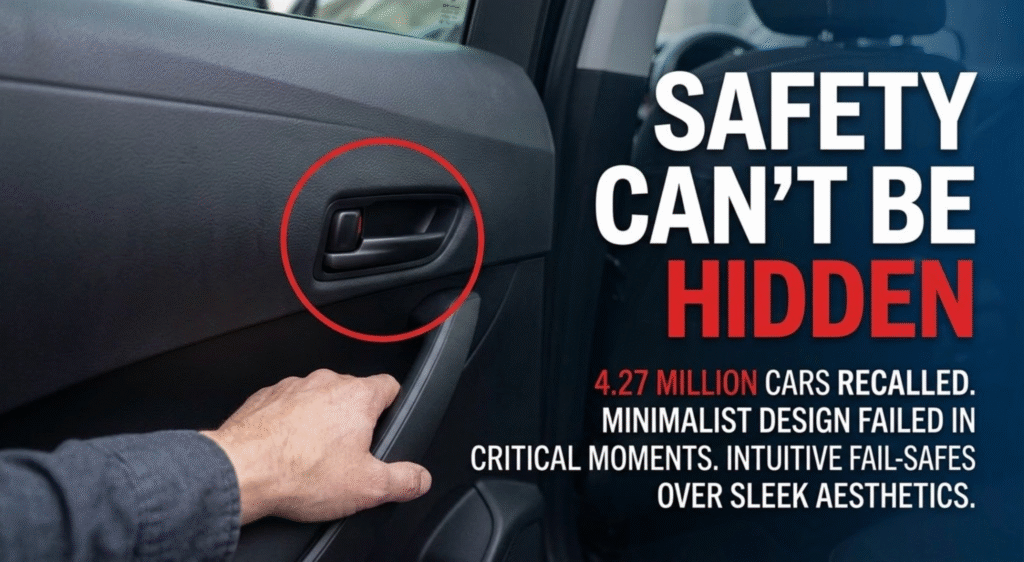
A mechanical door handle painted the wrong color.
On August 21, China’s Market Regulator issued one of the largest simultaneous recalls in EV history.
Tesla, Xiaomi, Xpeng, Zeekr, and 5 others had to call back millions of cars.
The core issue:
In a crash, low-voltage power fails.
Electronic doors lock up.
The backup mechanical latch?
Blended so seamlessly into the interior trim that passengers couldn’t find it to escape.
As automotive engineers, we love chasing slick, minimalist design.
Hidden handles. Monolithic dashboards. Zero physical buttons.
It looks futuristic in the showroom.
It fails in a split-second emergency.
Here are 3 hard lessons every product builder should remember:
1. Form follows function. Safety precedes form.
When your aesthetic choice compromises human safety, it isn’t “clever design” – it’s an engineering defect.
2. Fail-safes must be intuitive, not invisible.
If a user needs a manual or a torchlight to find the emergency override, the fail-safe doesn’t exist.
Redundant mechanical systems must be unmissable.
3. Edge cases aren’t edge cases when you scale.
A 0.01% scenario (total power loss + crash) scaled across millions of fleet vehicles becomes a statistical certainty.
Build for the absolute worst-case moment.
Great design isn’t just about how sleek something looks when everything works.
It’s about how clearly it saves a life when everything fails.
✍️ What’s your take: Are modern car interiors prioritizing tech aesthetics over basic usability?