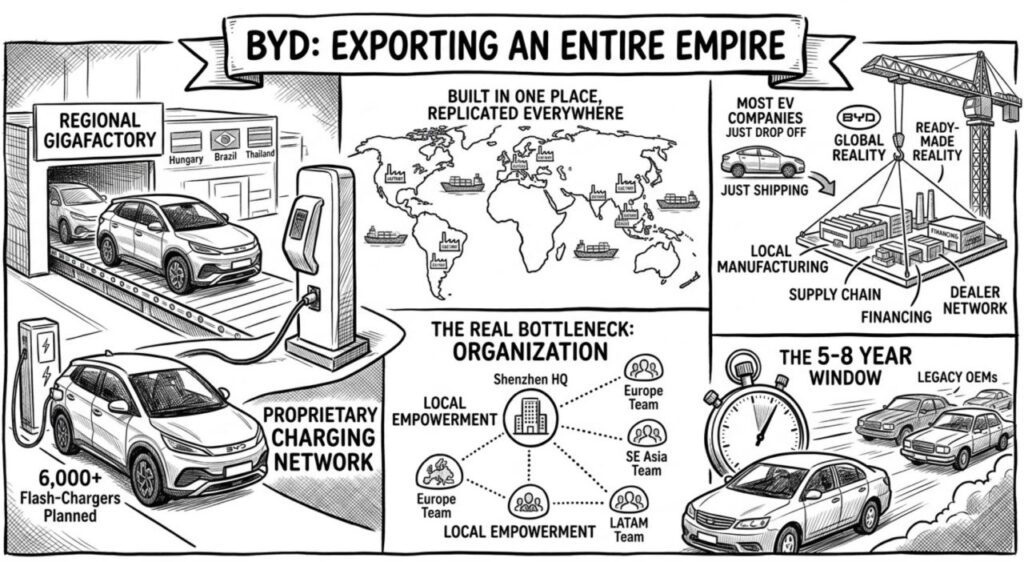
BYD isn’t just exporting cars.
They are rebuilding their entire domestic empire in real-time, across every continent.
Most EV companies build a car and ship it overseas.
BYD builds an entire vertical integration machine from scratch in every single market.
Domestic advantage? High volume, low unit cost, built-in infrastructure.
Global reality? Fragmented markets, low initial volumes, zero infrastructure.
When you export a car, you rely on local partners.
When BYD exports, they are forced to build:
• Regional Gigafactories (Hungary, Brazil, Thailand)
• Proprietary charging networks (6,000+ planned flash-chargers)
• In-house financing, dealer networks, and spare parts logistics
They aren’t running an export play. They are running a sovereign infrastructure play.
The real bottleneck isn’t capital or engineering. It’s organizational capability.
Moving from a hyper-centralized command structure in Shenzhen to a distributed, locally empowered decision model is the hardest transition a manufacturing giant can make.
The global window is 5 to 8 years before legacy OEMs fully mobilize their global footprint.
If BYD executes this localized vertical integration in time, they don’t just compete, they own the ecosystem.
Building a global auto giant used to take 20 years.
BYD is attempting it in less than a decade.
✍️ Which model wins in the long run: light-asset local partnerships or heavy-asset full vertical integration?