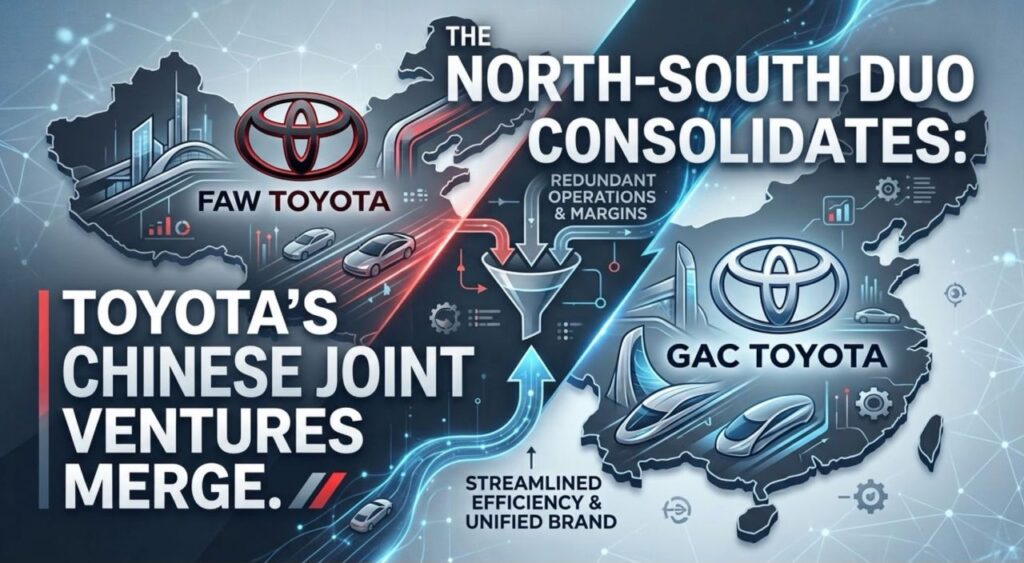
The end of an era in global auto manufacturing.
Toyota is officially moving to consolidate its two long-standing Chinese joint ventures – FAW Toyota and GAC Toyota.
For decades, foreign OEMs thrived in China using a “North-South” dual-JV playbook.
Build two identical cars.
Name them slightly differently (Corolla vs. Levin, RAV4 vs. Wildlander).
Pit two state-owned giants against each other.
Double your market footprint.
It worked brilliantly. Until it didn’t.
Here is what this restructuring signals for the global auto industry:
1. The “Twin-Car” Strategy is Dead
Running parallel supply chains, redundant marketing campaigns, and separate dealer networks to sell essentially the same car was sustainable during 15% annual market growth.
In an era of intense price wars and brutal EV transition, it’s fatal burn rate.
2. Consolidation Over Expansion
Toyota’s combined market share across both JVs fell to ~7% in 2026, down from ranking #2 behind Volkswagen just a few years ago.
When legacy ICE volume contracts, defense means stripping out duplicate overhead to protect margins.
3. Operational Efficiency ≠ Product Competitiveness
Merging sales operations and cutting factory redundancies fixes the balance sheet.
But as industry analysts point out, consolidating JVs doesn’t magically fix software, smart-cockpit, or battery architecture gaps against native Chinese OEMs like BYD.
Efficiency buys you time. Product relevance wins the market.
We are watching the structural rewiring of legacy automotive in real time.
The OEMs that survive the next 5 years won’t just be the ones building the best cars – they’ll be the ones ruthless enough to simplify their operational matrix before the market forces their hand.
✍️ What’s your take? Will consolidation be enough for legacy brands to hold ground in China, or is the software gap already too wide?